In This Article
- You Love Your Puppy—But That Midnight Cuddle May Be Backfiring
- What Nighttime Separation Anxiety Really Looks Like
- Getting Started: Stop Reinforcing the Panic
- Core Concepts Explained
- The Extinction Burst
- Desensitization and Counterconditioning
- Your First Calm Night: A 3‑Step Quick Win
- Common Beginner Mistakes to Avoid
You Love Your Puppy—But That Midnight Cuddle May Be Backfiring
You hear a whimper from the crate at 2 AM, and your heart sinks. You tiptoe over, whisper reassurances, maybe even bring the puppy to bed for a few minutes. It feels like comfort. But here’s what you might not realize: every time you respond that way, you’re teaching your puppy that crying at night works. The result? The anxiety gets louder, longer, and more entrenched. After reading this guide, you’ll recognize the specific, well-meaning habits that accidentally worsen your puppy’s nighttime fear—and replace them with a science-backed plan that builds calm independence from the ground up.
What Nighttime Separation Anxiety Really Looks Like
Nighttime anxiety isn’t just “puppy being dramatic.” It’s a genuine fear response triggered by being alone in the dark, away from the safety of its pack. Your puppy’s brain interprets solitude as a threat. Panting, pacing, whining, barking, or destructive chewing are not acts of rebellion—they are distress signals. Understanding this distinction is crucial because punishing the symptoms will only confirm that the dark is dangerous. The goal isn’t to silence your puppy, but to teach its nervous system that nighttime solitude is safe.
Getting Started: Stop Reinforcing the Panic
Before you teach a new bedtime routine, you must stop accidentally rewarding the old one. Here are three immediate changes:
- Don’t respond to the first whimper. Wait at least 10–15 seconds of silence before even acknowledging your puppy. If you rush in at the first sound, you train it that crying brings you instantly.
- Keep interventions boring. If you must check on your puppy, do it without eye contact, soft talk, or physical affection. A quiet “good night” and a quick hand on the crate door is enough. Excitement from you signals that wakeful time is fun.
- Never punish fear. Yelling, scolding, or starting the crate will increase anxiety. Your puppy will learn that nighttime means unpredictable, scary human reactions.
These first steps feel counterintuitive because they require you to withhold the very comfort you desperately want to give. But they are the foundation of teaching self-soothing.
Core Concepts Explained
The Extinction Burst
When you stop responding to crying, the behavior often gets worse before it gets better. This is called an extinction burst—your puppy tries harder to get the response that used to work. Owners frequently interpret this as “ignoring is cruel” and give in, cementing an even stronger habit. If you can ride out the burst (usually 1–3 nights), the crying typically drops off sharply.
Desensitization and Counterconditioning
Desensitization means exposing your puppy to nighttime separation in tiny, non‑scary doses. Counterconditioning pairs that exposure with something positive (like a stuffed Kong). Together, they rewire the emotional response from fear to contentment.
The Alone Zone
Your puppy needs to learn that the crate or room it sleeps in is a safe, independent space—not just a prison you leave it in. Building “alone time” during the day (5–15 minutes of quiet crate time while you’re home) removes the surprise factor at night.
Your First Calm Night: A 3‑Step Quick Win
This exercise will not fix months of built‑up anxiety overnight, but it will start shifting the pattern. Do it on a night when you have no early obligations the next morning.
- Full bedtime routine (60 minutes before lights out). Play lightly, then feed a meal, then take a final potty break. No more water 90 minutes before bed.
- Crate with a high‑value stuffed toy. Freeze a smear of plain yogurt or mashed banana inside a safe chew toy and give it only when you leave the room. The novel taste and frozen texture keep the puppy occupied for 20–30 minutes.
- Leave the room silently. Do not linger, do not say “okay, goodnight,” do not kiss the crate. Close the door and walk away. If crying starts, wait at least 5 minutes before any response. If you must intervene, follow the “boring check” rule above.
This single night of consistent, calm departure often reduces the first round of crying by half. You’ll have a baseline to improve upon.
Common Beginner Mistakes to Avoid
Mistake #1: Sleeping in the Same Room Indefinitely
Many owners let the puppy sleep in the bedroom for the first two weeks, then move the crate to the living room. The sudden change causes panic. Better: start the crate in its final location from day one, with you nearby for the first few nights, then gradually move farther away.
Mistake #2: Using Potty Breaks as Social Moments
When your puppy cries at 3 AM needing to eliminate, take it out on a leash and stay silent. No talking, licking, or playing. Return to the crate immediately. Otherwise, the puppy learns that barking leads to fun middle‑of‑the‑night outings.
Mistake #3: Skipping Daytime Alone Practice
If your puppy is only left alone at night, bedtime becomes the only time it practices being alone—and that’s high‑stakes. Schedule three to five short alone sessions during the day (less than 15 minutes each) to teach that solitude is normal and temporary.
Mistake #4: Ignoring the Physical Environment
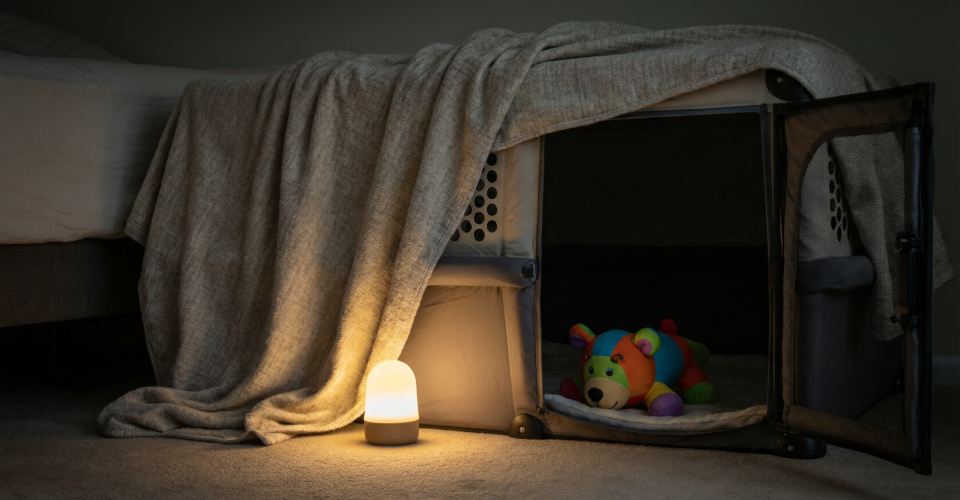
A too‑large or too‑small crate can amplify anxiety. The crate should be just big enough for the puppy to stand, turn around, and lie down. Cover it with a lightweight blanket to create a den‑like atmosphere. White noise or a heartbeat toy can mask outside sounds.
Mistake #5: Changing the Routine After a Few Good Nights
Consistency is everything. Once you establish a schedule (“potty at 10 PM, crate by 10:30, no response until 5 AM”), stick to it for at least three weeks. Every change resets the learning curve.
FAQ: Real Questions From Puppy Owners
Should I ignore my puppy’s crying completely?
Not entirely. If the crying is persistent and you suspect a potty need, take it out silently (see Mistake #2). Otherwise, wait for a pause of at least 10 seconds before a very boring check. The goal is to reward quiet, not crying.
How long does it take for a puppy to stop crying at night?
Most puppies show significant improvement within 5–10 nights of consistent, non‑reinforcing responses. Full comfort can take 3–6 weeks, depending on age and previous experience.
What if my puppy is genuinely scared of the dark?
Puppies don’t fear darkness itself—they fear being alone and vulnerable. A nightlight or low‑level sound machine can help by providing sensory comfort, but the core solution is building confidence through gradual alone time.
Is it okay to use a crate cover?
Yes, as long as the puppy doesn’t overheat. A breathable crate cover can reduce visual stimuli and create a den‑like feel. Observe your puppy: if it pulls the cover inside or chews it, remove it for safety.
My puppy is destructive in the crate—what do I do?
Destruction is a sign of high anxiety, not naughtiness. First, ensure the crate is comfortable (soft bed, safe chew toy). Then, slowly increase crate duration during the day from very short (1 minute) to longer periods. For severe cases, consult a force‑free trainer.
When should I seek professional help?
If your puppy’s crying lasts longer than 20–30 minutes, includes self‑harm (e.g., pawing at crate until raw), or if you feel your own stress is affecting your actions, contact a certified separation anxiety specialist who uses behavior modification, not punishment.
Next Steps: Build the Foundation for a Lifetime of Confident Nights
You now know the biggest ways well‑meaning actions can backfire. The next layer is systematic alone training: leaving your puppy for very short periods during the day, rewarding calm, and slowly increasing distance. Our guide “The Complete Puppy Alone Training Schedule” walks you through a day‑by‑day plan. You might also explore desensitization to your “departure cues” (jingle of keys, putting on shoes) so your puppy doesn’t panic the moment you reach for the door. And remember: your calm is contagious. The more you act like nighttime solitude is no big deal, the more your puppy will believe it too.

Leave a Reply